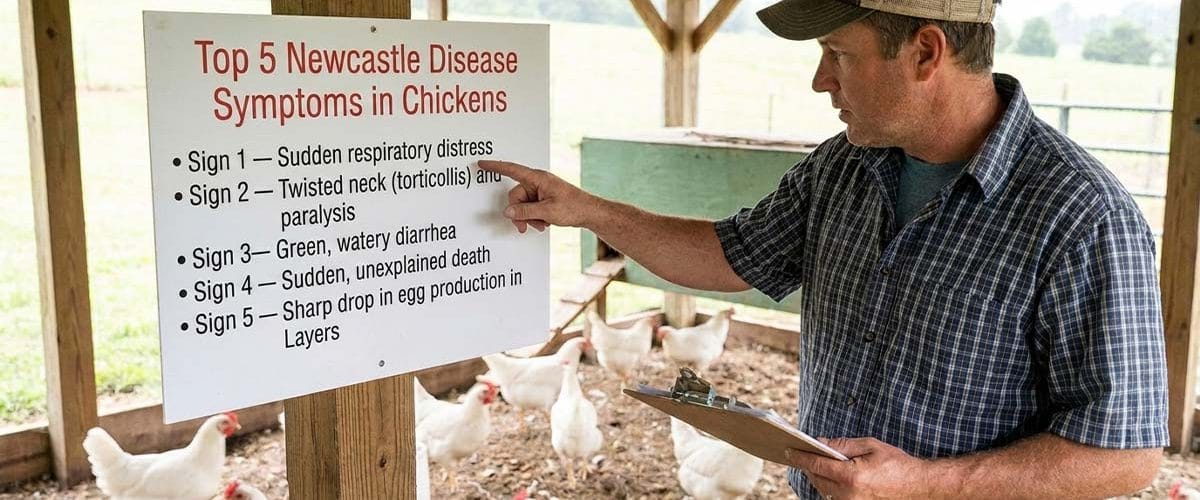
Top 5 Signs of Newcastle disease in poultry in Your Flock
Newcastle disease in poultry, locally known as Ranikhet disease of ND, is one of the most destructive and financially devastating poultry diseases in Pakistan. Whether you are running broilers in Punjab or a layer farm in KPK, a single Newcastle Disease (ND) outbreak can kill 80–100% of an unvaccinated flock within 7–10 days. Yet despite its severity, many Pakistani poultry farmers miss the early warning signs until it is too late.
This guide covers the top 5 Newcastle disease symptoms in chickens, what each sign means, and the exact steps to take the moment you suspect an outbreak on your farm.
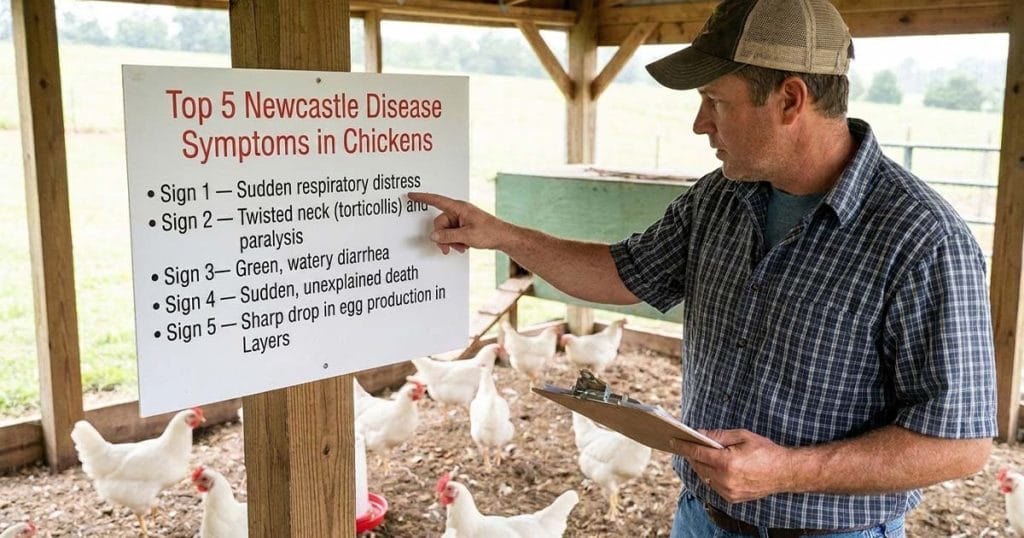
Top 5 Newcastle disease in poultry Symptoms in Chickens
- Sign 1: Sudden respiratory distress: Coughing, sneezing, gasping for air, and rattling or gurgling sounds across the shed. This is usually the first symptom of Newcastle disease to appear, within 2–5 days of exposure. Do not confuse with Infectious Bronchitis ND typically spreads faster and hits harder.
- Sign 2: Twisted neck (torticollis) and paralysis: Birds holding their head sideways or backward, walking in circles, or unable to stand. Neurological signs in poultry alongside breathing problems are a classic indicator of velogenic (severe) Newcastle disease. If you see this, act immediately.
- Sign 3: Green, watery diarrhea: Loose, distinctly green droppings spreading rapidly across pens. The virus attacks the intestinal lining, causing fluid loss and dehydration. Wet litter from diarrhea then accelerates virus spread, compounding losses across your whole farm quickly.
- Sign 4: Sudden, unexplained death: Multiple birds found dead overnight with no prior visible sickness. In unvaccinated or improper poultry flocks, velogenic strain of Ranikhet disease has caused losses of entire sheds within a week. Post-mortem haemorrhages on the proventriculus and intestines are a key diagnostic clue.
- Sign 5: Sharp drop in egg production in Layers: A fall of 30–70% in egg output within days, often before birds appear visibly sick. Eggs may be soft-shelled, misshapen, or pale. Even mild ND strains can devastate layer flocks. Recovery of full egg production can take 4–8 weeks after treatment.
| Immediately call your veterinarian if you see any combination of these signs |
| Respiratory distress + twisted neck | Mass overnight deaths | Egg drop >20% in 48 hours |
| Green diarrhoea spreading flock-wide | No response to standard antibiotic treatment |
What to Do If You Suspect Newcastle Disease
- Isolate sick birds immediately, restrict all movement between sheds, change clothing, and disinfect footwear before entering any other area.
- Proper Diagnosis, ND shares symptoms with Avian Influenza and Mycoplasma. A veterinarian can confirm the diagnosis and guide treatment.
- Support your surviving birds, add electrolytes and vitamins (Vitapro D, VITA-RICH-D) to drinking water to combat dehydration. Use a vet-prescribed broad-spectrum antibiotic like Tylconor or Norflox P forte to prevent secondary bacterial infections.
- Disinfect everything, clean all sheds, water lines, feeders, and equipment thoroughly before restocking.
How to Prevent Newcastle Disease in Pakistan
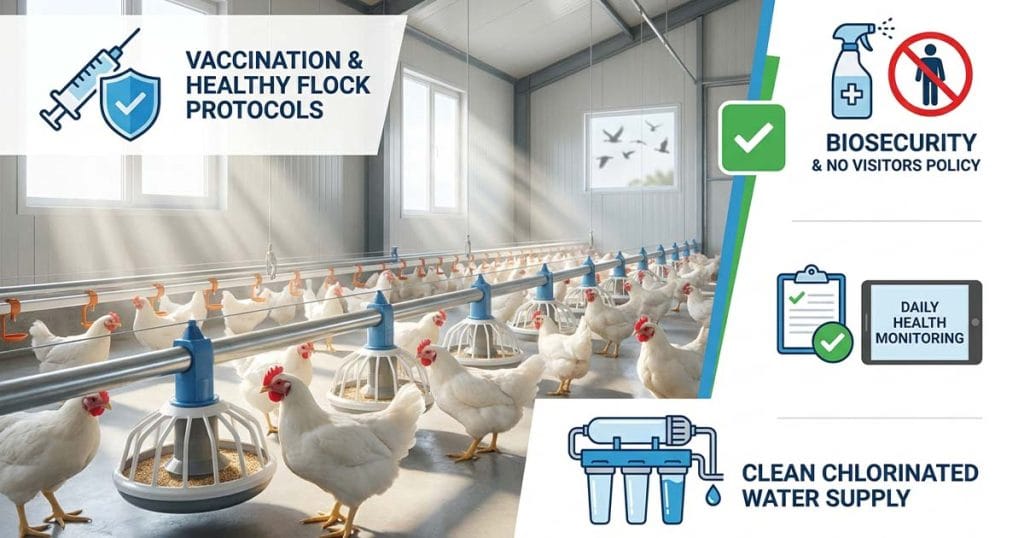
There is no specific antiviral cure for Newcastle Disease. Prevention through vaccination is the only reliable protection, and it is non-negotiable for any serious poultry operation in Pakistan.
- Vaccinate using live attenuated ND vaccine (Lasota/B1 strain) at Day 7, Day 21, then every 6–8 weeks.
- Biosecurity, control visitor access, vehicle entry, and wild bird exposure daily.
- Water hygiene, chlorinate lines and clean drinkers daily to eliminate environmental virus load.
- Daily monitoring, inspect flock behaviour and droppings every morning. Early detection saves flocks.
Newcastle Disease (Ranikhet) is endemic in Pakistan, the virus never fully disappears. Your vaccination schedule and daily biosecurity habits are your farm’s only reliable defence.
| Need the right products to protect your flock? |
| DMG Pharmaceutical offers Vitapro D, VITA-RICH-D, Tylconor, Norflox P forte, FRA C12 and Respizan and a full range of poultry health |
| solutions trusted by thousands of farmers across Pakistan. |
| Visit: www.dmgpharmaceutical.com | Call: 0311-4461691 |
Frequently Asked Questions (FAQs)
What is Newcastle disease called in Pakistan?
Newcastle Disease is locally known as ND or Ranikhet disease (Ranikhet bimari) in Pakistan and is one of the most common poultry diseases reported by farmers across Punjab, KPK, and Sindh.
Can Newcastle disease be treated?
There is no specific antiviral treatment for Newcastle Disease. Supportive care — electrolytes, vitamins, and antibiotics to prevent secondary infections — can reduce mortality, but vaccination before exposure is the only true protection.
How fast does Newcastle disease spread?
Extremely fast. In an unvaccinated flock, the velogenic strain can kill 80–100% of birds within 7–10 days. Symptoms appear 2–5 days after exposure and the virus spreads through air, contaminated water, equipment, and direct contact.